
During the March 3 County Commissioners Meeting, the Bureau of Land Management (BLM) presented an update on the proposed Greenlink North transmission line project. Brian Buttazoni, project manager for the BLM, presented an overview of the project and recent developments in the federal review process.
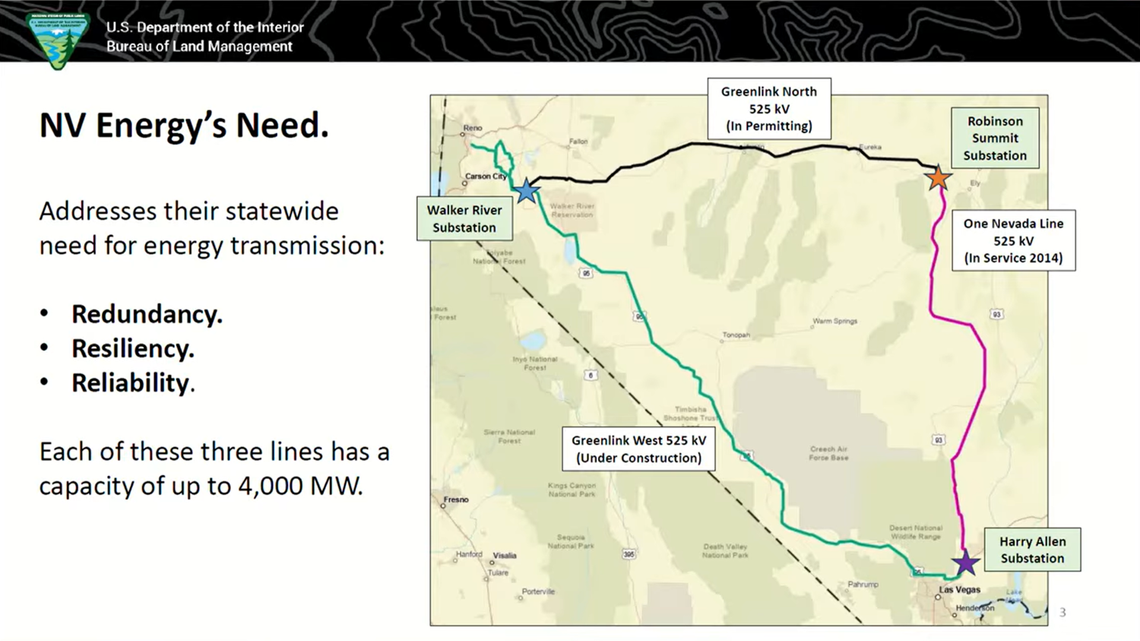
Greenlink North is a proposed 235-mile transmission line that would connect the Robinson Summit substation in Elko County with the Walker River substation in Lyon County. According to Buttazoni, “NV Energy has stated that their need for the Greenlink North transmission line project is to facilitate a triangle across the state of Nevada for energy transmission, redundancy, resiliency, and reliability.”
The line would be the third segment in a statewide transmission network. Buttazoni noted that the eastern side of the transmission system went into service in 2014, while the Greenlink West project on the western side of the state was approved in September 2024 and is currently under construction.
Buttazoni highlighted the adjustments made to the proposed route. At the Popcorn Mine, the transmission line was shifted to create a roughly two-mile bypass around the mine’s operations. The alignment was also adjusted to move the route away from the City of Fallon landfill and from certain Recreation and Public Purposes Act parcels designated through federal legislation in 2024.
The project would also pass through the Dixie Valley Training Area. Congress previously designated a half-mile-wide utility corridor in that area when the Fallon Naval Air Station and Dixie Valley Training Area were expanded in 2024, and the transmission line would be located within that corridor.
The BLM examined about 20 route alternatives and route segments during the planning process before arriving at these solutions. Previous suggestions included rerouting the project north toward I-80 and Wells before returning south to the Walker River substation. However, those alternatives would significantly increase project costs and the number of transmission structures required.
The current 235-mile line is estimated to cost about $832 million. According to Buttazoni, alternative routes extending north toward I-80 would increase costs to between $1.1 billion and $1.6 billion while also increasing environmental impacts and the number of transmission structures. The BLM also considered proposals to place the transmission line underground, but Buttazoni said undergrounding a 525-kilovolt line over that distance has never been done in the United States and could increase costs to at least $6.5 billion.
Much of the project area overlaps with greater sage-grouse habitat, which has affected construction planning and environmental review. Approximately 155 miles of the project corridor are within areas subject to habitat restrictions tied to sage-grouse population trends. However, according to Buttazoni, “All of these other alternatives increase the impacts to those resource concerns.”
Supplemental environmental documents are currently being prepared to address several developments in the project review, including a June 2025 letter from Gov. Joe Lombardo. The letter recommended modifying or removing seasonal construction restrictions in greater sage-grouse habitats. Under earlier restrictions, construction could occur for about 45 days each year in certain areas. A partial exemption announced in 2024 extended that window to roughly five and a half months, while the new alternative would allow for a 365-day construction period.
Other supplemental documents will address protests and changes made in December 2025. When large projects such as Greenlink North are launched, they must undergo a 30-day protest period. The project received three protests, and a protest report was returned to the BLM for further consideration. In December 2025, the California and Nevada state directors approved a new plan amendment governing how projects are managed in greater sage-grouse habitat. The amendment changed general habitat management areas from an “avoidance” designation to “open,” while priority habitat management areas remain designated as avoidance but can now be considered “open” if certain avoidance criteria are met.
BLM expects to release the supplemental documents for a 30-day public comment period beginning around March 27. According to Buttazoni, “If we're able to achieve that comment period starting on March 27th, then we would be looking at both the Bureau of Land Management and Forest Service issuing their decisions in June.”
Following federal decisions, NV Energy would still need to obtain approval from the Nevada Public Utilities Commission before construction could begin. Construction could start in early 2027 if approvals move forward as anticipated. NV Energy is required under state law to have the transmission line operational by December 2028.
During the presentation, a commissioner asked how much power would be delivered to Churchill County from the line. According to Buttazoni, “The capacity of the line is up to 4,000 megawatts.” He noted that the BLM will work to provide more information on that directly from NV Energy in the future.


Comment
Comments