

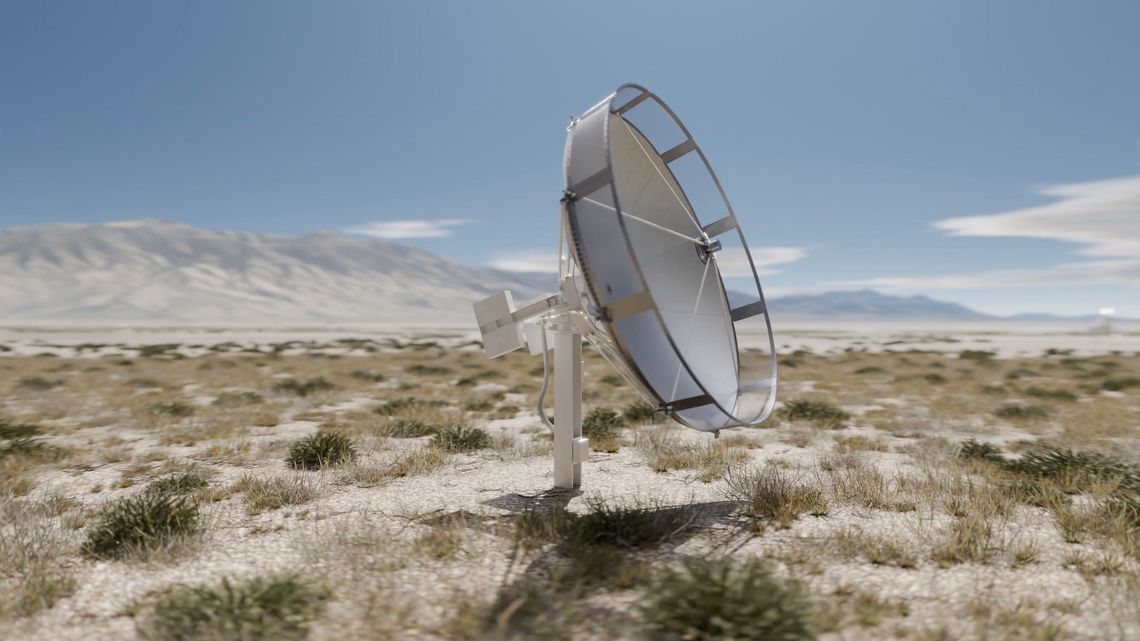
A remote valley in eastern Nevada could soon become home to the world’s most sensitive radio telescope, an enormous scientific instrument designed to photograph the radio sky faster and in greater detail than ever before.
The California Institute of Technology announced in June that its Deep Synoptic Array has passed its final engineering design review and secured construction funding from Schmidt Sciences. The project would place 1,650 radio dishes across northern Spring Valley in White Pine County, northwest of Ely.
Each dish would measure slightly more than 20 feet across. Together, the dishes would stretch across an area approximately 12 miles long and 10 miles wide, functioning as one enormous telescope. Caltech plans to complete construction by 2029, with scientific operations beginning soon afterward.
The project, however, still faces federal environmental review before full construction can proceed on public land.
The Bureau of Land Management approved limited geotechnical testing on approximately 16 acres in April. That testing will allow engineers to examine soil and ground conditions in the proposed project area.
The BLM release emphasized that the decision is an interim approval required for the project’s review under the National Environmental Policy Act and is not a final right-of-way grant for the larger telescope array.
Caltech submitted its federal right-of-way application in September 2023. Earlier BLM documents described the proposed project area as approximately 63,250 acres of public land in northern Spring Valley. The agency also established a working group involving state and federal wildlife officials and Caltech to examine potential effects on wildlife and other resources.
When completed, the Deep Synoptic Array would survey the sky approximately 100 times faster than any existing radio telescope, according to Caltech.
Radio telescopes do not capture ordinary visible light. Instead, they detect radio waves produced by stars, galaxies, black holes and other objects throughout the universe. Scientists combine signals collected by multiple dishes to create detailed images.
The Nevada array’s 1,650 dishes would continuously send data through fiber-optic lines to a powerful computer system. The computer would process the signals immediately, producing what Caltech researchers describe as the world’s first real-time “radio camera.”
Traditional radio-telescope data can take weeks or months to process into usable images. The new system is intended to produce those images almost instantly.
Caltech estimates that the array will collect raw information at a rate comparable to all internet traffic in the United States. Storing all of that raw data would require approximately 5 million computer hard drives. Instead, the system will process the information as it arrives and save the completed images.
Researchers expect the telescope to identify approximately 1 billion previously unknown radio sources during its first five-year survey. Caltech says the array could match, on its first day of operation, the roughly 20 million radio sources discovered by all other radio telescopes combined.
Scientists intend to use the telescope to study black holes, pulsars, exploding stars, dark matter, gravity and the expansion of the universe.
It will also search for fast radio bursts, intense flashes of radio energy lasting only fractions of a second. Although astronomers have traced some of the bursts to distant galaxies, their origins remain one of astronomy’s major unanswered questions.
The project is expected to detect more than 100,000 of the bursts and identify the galaxies from which they came.
Caltech says images produced by the telescope will be available freely to scientists and members of the public without a proprietary waiting period.





Comment
Comments