
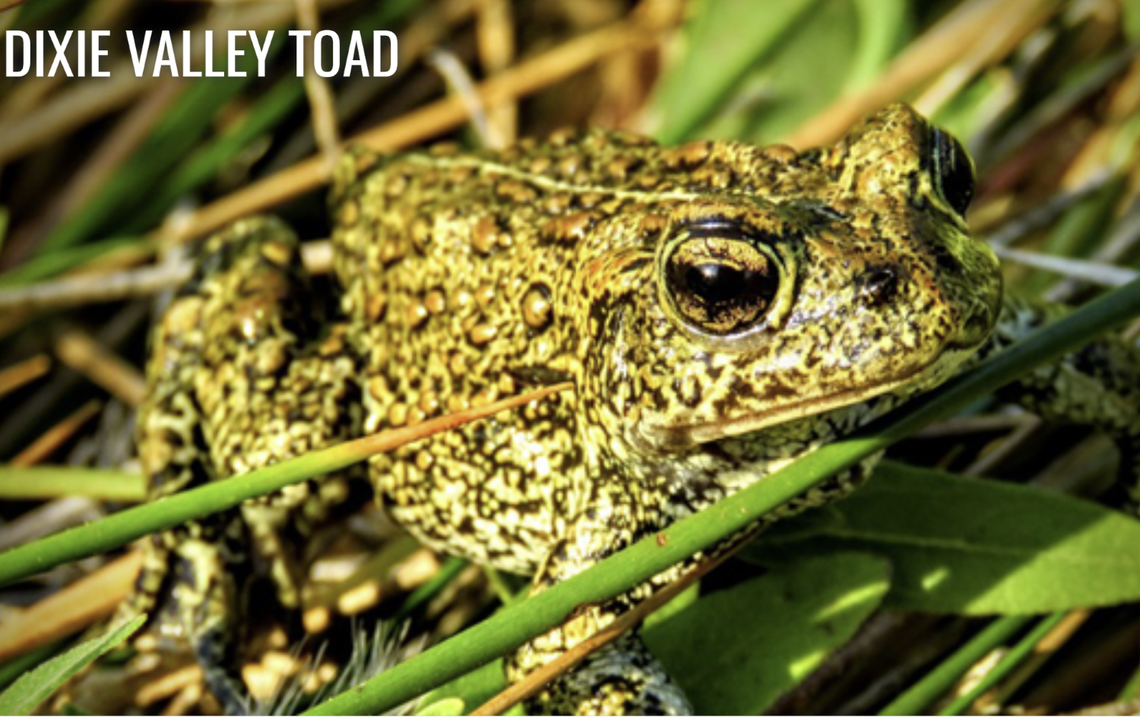
On Jan. 13, 2026, The Center for Biological Diversity (CBD) and the Fallon Paiute Shoshone Tribe filed a legal intervention to protect Dixie Valley toads from a Nevada geothermal plant. The intervention asks to allow these groups to argue against a lawsuit brought by the geothermal company, Ormat, that would take Endangered Species Act protections away from the toad.
A legal intervention is a formal request by an outside party to join an ongoing lawsuit. The party must demonstrate that the court’s decision could have a direct impact on its legally protected interests.
The Dixie Valley toad is found only in Dixie Meadows, a 760-acre wetland in Churchill County. It is unique due to its complete adaptation to the warm, geothermal springs of Dixie Meadows. According to U.S. Geological Survey studies, the toads actively seek out the warmest waters, particularly during breeding season in spring and during winter brumation, a hibernation-like state. While other western toads burrow underground to survive winter, Dixie Valley toads remain in the warm spring waters to avoid freezing.
In 2017, the Dixie Valley toad was one of the first new toad species to be discovered in the United States in nearly 50 years. At around 2.2 inches long, it is the smallest member of the western toad family. Unlike other species that breed in water and then move to dry land, the Dixie Valley toad is highly aquatic, and rarely found more than 46 feet from water. In Dec. 2022, the U.S. Fish and Wildlife Service (USFWS) officially listed it as endangered.
During a May 2022 public hearing, Patrick Donnelly of the Center for Biological Diversity argued that protecting the toad was about more than one species. According to Donnelly, "The Dixie Valley toad might just seem like a tiny little toad in a remote marsh somewhere, but it is a piece of Nevada's incredible biodiversity.” In 2023, USFWS proposed designating approximately 930 acres in Dixie Meadows as critical habitat. About 63% sits on U.S. Navy land as part of Naval Air Station Fallon, with the rest in Bureau of Land Management territory.
In 2025, Ormat sued the U.S. Fish and Wildlife service in an attempt to remove protections for the Dixie Valley Toads. If the recent intervention to protect this species is approved by the court, the motion would allow the Center for Biological Diversity and the Fallon Paiute Tribe to join the USFWS in defending Dixie Valley toads against the Ormat lawsuit.
“We’ve been standing with our tribal partners to fight for this toad for almost a decade,” said Donnelly. “Ormat’s cynical lawsuit flies in the face of established science and is based on flawed legal interpretations. We won’t back down in our fight to save the Dixie Valley toad.”


Comment
Comments